
New report: Cycling and Walking Data for Multi-Modal Journey Planning
Almost every public transport journey starts and ends on foot or by bike, yet these are the parts of a journey least well described in journey-planning data. In London alone, residents make 6.2 million walk-only trips a day, and UK bike share recorded nearly 25 million hires in the year to September 2023. RTIG's new report, Cycling and Walking Data for Multi-Modal Journey Planning (RTIGT070), sets out good practice for describing walking, cycling and shared micromobility so that journey planners can route across them reliably.
QR Codes at Bus Stops
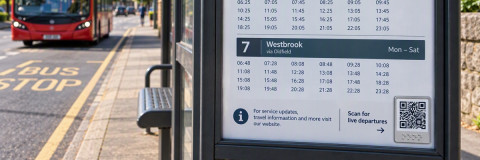
A QR code on a bus stop only helps passengers if it is easy to find, quick to scan and safe to trust.
This good practice guidance, QR Codes at Bus Stops, gives local authorities, bus operators and suppliers a practical, implementation-ready standard for getting it right.
Christmas & New Year Timetable Data 2026-27

The Bus services around the Christmas and New Year period will often operate differently to normal weeks.
The data for use in services such as the Department for Transport Bus Open Data Service , Traveline, journey planners, real time systems and mobile phone apps all need to be updated to reflect the changed operation.
This advice deals with how to prepare data for the BODS and other systems to ensure that it is correct for the Christmas and New Year 2026-27 holiday period.
Update to Non-Passenger Stops in Real Time Systems

There is a requirement to indicate non-passenger stops (driver rests, driver change over, depots, and waiting time stops) so that these can be included in TransXChange (TXC) files in National Coach Service Database (NCSD), and Bus Open Data Service (BODS) without requiring a stop to be created in the NaPTAN database by an authority. These locations are not used by the public to access or exit public transport, they are required for operational management purposes by operators.
Barcode Ticket for Public Transport (BT4PT)

Introduction
Seamless multimodal and multi-operator travel across Europe is a major goal of EU transport policy. This goal is based on environmental arguments (less pollution, sustainability, EU climate targets), economic arguments (less energy consumption, less congestion) and social arguments (making it easier for citizens to work, study, and do business across borders).
One of the facilitators of this European transport is the development of a standard to integrate electronic ticketing for all public transport modes in all countries of Europe.
Transport Data Action Plan

The Transport Data Action Plan (DAP) sets out the Department for Transport’s (DfT) commitments to improve how transport data is used, shared and understood across the sector.
It aims to enable:
OpRa Operating raw data and statistics exchange

OpRa is a CEN initiative with main focus on the identification of Public Transport raw data to be exchanged, gathered and stored in order to support Study and Control of Public Transport Service.
The project initially produced a CEN Technical Report.
Recently work has taken place to develop a new Technical Specification (TS) and update the existing Transmodel Part 8 document.
These documents are now at the stage of initial comment on the principles which have been created and documented, prior to completion of the work.
Christmas & New Year Timetable Data 2025-26

The Bus services around the Christmas and New Year period will often operate differently to normal weeks.
The data for use in services such as the Department for Transport Bus Open Data Service , Traveline, journey planners, real time systems and mobile phone apps all need to be updated to reflect the changed operation.
This advice deals with how to prepare data for the BODS and other systems to ensure that it is correct for the Christmas and New Year 2025-26 holiday period.
CMS to PID Interface Protocol v2 Released

The initial versions have been tested on street and Version 2 developed to address implementation issues identified and reduce the amount of project specific details necessary:
Part 1 - Architecture (Published) v2.0
https://rtig.org.uk/documents/rtigt047-pt1-2
Part 2 – Core Content Messages (Published) v2.0
https://rtig.org.uk/documents/rtigt047-pt2-2
Use of Non-Passenger Stops in Real Time Systems
There is a requirement to indicate non-passenger stops (driver rests, driver change over, depots, and waiting time stops) so that these can be included in TransXChange (TXC) files in National Coach Service Database (NCSD), and Bus Open Data Service (BODS) without requiring a stop to be created in the NaPTAN database by an authority. These locations are not used by the public to access or exit public transport, they are required for operational management purposes by operators.